
How to File Capital Gains in ITR — Complete Guide AY 2026-27
STCG & LTCG rates, Schedule CG walkthrough, broker CSV import, property gains & Section 54/54F — all in one place
Last updated: July 2026 • 15 min read
Compute your capital gains tax for free
Upload broker P&L → get exact Schedule CG amounts to file
Table of Contents
1. Types of Capital Gains — STCG vs LTCG
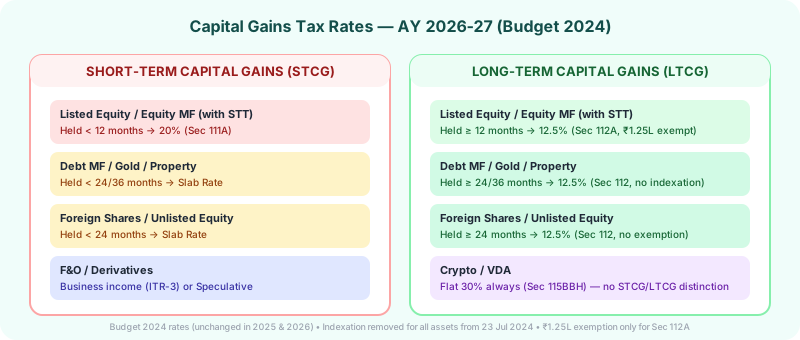
Capital gains in India are classified into Short-Term Capital Gains (STCG) and Long-Term Capital Gains (LTCG) based on how long you held the asset before selling. The holding period threshold and tax rate depend on the type of asset.
| Asset Type | STCG Rate | LTCG Rate | Section |
|---|---|---|---|
| Listed Equity / Equity MF (STT paid) | 20% (Sec 111A) | 12.5% above ₹1.25L (Sec 112A) | 111A / 112A |
| Unlisted Shares | Slab rate | 12.5% (Sec 112) | 112 |
| Debt Mutual Funds / Bonds | Slab rate | 12.5% (Sec 112) | 112 |
| Gold / Gold ETF / Gold MF | Slab rate | 12.5% (Sec 112) | 112 |
| Real Estate / Property | Slab rate | 12.5% (Sec 112) | 112 |
⚠️ Budget 2024 Change: Indexation Removed
From 23 July 2024, indexation benefit has been removed for all asset classes. All LTCG is now taxed at a flat 12.5% without indexation. This applies to property, gold, debt funds, and unlisted shares.
Key point: Listed equity LTCG (Section 112A) has an annual exemption of ₹1.25 lakh per assessee. Gains up to ₹1.25L are completely tax-free. This exemption does NOT apply to other asset classes under Section 112.
2. Holding Period Rules by Asset Type
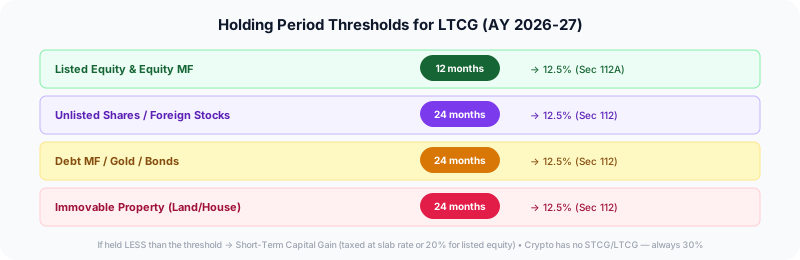
The holding period determines whether your gain is short-term or long-term. Different assets have different thresholds:
| Asset Type | LTCG Threshold | STCG if held less than |
|---|---|---|
| Listed Equity Shares | ≥ 12 months | < 12 months |
| Equity-oriented MF / ETF (STT paid) | ≥ 12 months | < 12 months |
| Debt Mutual Funds / Bonds | ≥ 24 months | < 24 months |
| Gold / Gold ETF / Sovereign Gold Bonds | ≥ 24 months | < 24 months |
| Unlisted Shares | ≥ 24 months | < 24 months |
| Immovable Property (Land/House) | ≥ 24 months | < 24 months |
Grandfathering Rule for Listed Equity (Sec 112A)
For listed shares/equity MF units held before 1 February 2018, the cost of acquisition is the higher of:
(a) Actual purchase price, OR
(b) Fair Market Value on 31 January 2018 (highest price on stock exchange on that date)
This "grandfathering" ensures that gains accrued before 1 Feb 2018 remain tax-free.
3. How to Compute Capital Gains
The basic formula for computing capital gains:
Components Explained
- Sale Price (Full Value of Consideration): Actual amount received on sale. For property, if sale price < stamp duty value by >10%, stamp duty value is deemed as sale price (Sec 50C).
- Cost of Acquisition: Purchase price of the asset. For listed equity bought before 1 Feb 2018, apply the grandfathering rule. For inherited/gifted assets, use the cost to the previous owner.
- Cost of Improvement: Capital expenditure on improvement (not repairs/maintenance). Only improvements made after acquisition count.
- Expenses on Transfer: Brokerage, STT (for delivery-based trades), stamp duty, legal fees on property transfer.
Worked Example — Listed Equity
Bought 100 shares of Reliance at ₹2,000 on 1 Mar 2024.
Sold at ₹2,800 on 15 May 2025 (held 14+ months → LTCG).
Brokerage paid: ₹200.
Sale Value = 100 × ₹2,800 = ₹2,80,000
Cost = 100 × ₹2,000 = ₹2,00,000
LTCG = ₹2,80,000 − ₹2,00,000 − ₹200 = ₹79,800
Since ₹79,800 < ₹1.25L exemption → Tax = ₹0
Note: Post Budget 2024 (from 23 July 2024), indexation is no longer available for any asset class. All LTCG is computed on actual cost without CII adjustment. The earlier 20% with indexation option no longer exists.
4. Schedule CG on the ITR Portal
Capital gains are reported in Schedule CG of ITR-2 (or ITR-3 for business income). The schedule has separate sections for each asset type. Here's where to enter your data:
| Asset Type | Portal Section |
|---|---|
| Listed Equity (STT paid) | STCG → B1 (Sec 111A) / LTCG → B5 (Sec 112A) |
| Equity Mutual Funds (STT paid) | STCG → B1 (Sec 111A) / LTCG → B5 (Sec 112A) |
| Debt Mutual Funds | STCG → B4 (Other assets) / LTCG → B7 (Sec 112) |
| Unlisted Shares | STCG → B4 (Other assets) / LTCG → B7 (Sec 112) |
| Gold / Gold ETF | STCG → B4 (Other assets) / LTCG → B7 (Sec 112) |
| Property (Land/House) | STCG → B3 (Land/Building) / LTCG → B6 (Land/Building) |
For each transaction, enter:
- ISIN / Description: ISIN code for listed shares, or asset description for property
- Date of acquisition: Purchase date (or allotment/vesting date)
- Date of sale/transfer: Actual sale date
- Sale consideration: Total sale value received
- Cost of acquisition: Total purchase cost (apply grandfathering if applicable)
- Expenses on transfer: Brokerage + stamp duty + other charges
- Deduction under Sec 54/54EC/54F: If claiming property exemption
💡 TaxZen auto-maps your broker data to Schedule CG. Upload your broker P&L CSV and the app computes gains, applies grandfathering, and shows exact portal field values.
5. Broker CSV Import — Download Steps
Most Indian brokers provide a Tax P&L statement that contains all your equity and mutual fund transactions. Here's how to download from the top brokers:
Zerodha
- Log in to Console (console.zerodha.com)
- Go to Reports → Tax P&L
- Select financial year: FY 2025-26
- Click "Download CSV" for equity or mutual funds
- The CSV contains: ISIN, buy date, sell date, buy value, sell value, P&L, holding period
Groww
- Log in to Groww app or web
- Go to Reports → P&L Report
- Select FY 2025-26 and asset type (Stocks / Mutual Funds)
- Click "Download Report"
- The report separates realized gains (STCG/LTCG) with holding period classification
ICICI Direct
- Log in to ICICIdirect.com
- Go to Portfolio → Tax Centre
- Select assessment year: AY 2026-27
- Download the Capital Gains Statement
- The statement includes scrip-wise STCG/LTCG breakup with grandfathered cost
Tip: Always cross-check broker P&L with your AIS (Annual Information Statement) on the income tax portal. The portal pre-fills some capital gains data from broker reports — verify amounts match before filing.
6. Property Capital Gains — Section 54/54F Exemptions
Property sales attract capital gains tax, but you can claim exemptions if you reinvest the proceeds in another residential property.
Holding Period for Property
Immovable property (land, building, flat) is classified as long-term if held for 24 months or more. LTCG on property is taxed at 12.5% without indexation (post Budget 2024).
Section 54 — Residential House to Residential House
- Who can claim: Individual or HUF selling a residential property
- Condition: Purchase or construct ONE new residential house in India
- Timeline: Buy within 1 year before or 2 years after sale, OR construct within 3 years after sale
- Exemption amount: Lower of (LTCG amount) or (cost of new house)
- Lock-in: New house cannot be sold within 3 years, else exemption is reversed
- Capital Gains Account Scheme (CGAS): If new house not purchased by ITR filing date, deposit amount in CGAS to claim exemption now
Section 54F — Any Long-Term Asset to Residential House
- Who can claim: Individual or HUF selling any long-term capital asset (other than residential property)
- Condition: Invest the net sale consideration (not just gains) in ONE new residential house
- Restriction: On the date of sale, you must not own more than one residential house (other than the new one)
- Timeline: Same as Section 54 — buy within 1 year before / 2 years after, or construct within 3 years
- Exemption amount: Proportional — (Capital Gain × Amount Invested) ÷ Net Sale Consideration
Worked Example — Section 54
Sold a flat for ₹1.2 Crore (held for 5 years, cost ₹70 Lakh).
LTCG = ₹1,20,00,000 − ₹70,00,000 = ₹50,00,000
Tax without exemption = ₹50L × 12.5% = ₹6,25,000
If you buy a new house for ₹60L within 2 years:
Exemption u/s 54 = lower of (₹50L LTCG, ₹60L new house cost) = ₹50,00,000
Taxable LTCG = ₹0 → Tax = ₹0
⚠️ Section 50C: Stamp Duty Valuation
If you sell property below the stamp duty valuation (circle rate) by more than 10%, the stamp duty value is deemed as sale consideration for computing capital gains. This prevents under-reporting of property sale value.
7. Common Mistakes to Avoid
Filing ITR-1 when you have capital gains
Any capital gains income → ITR-2 is mandatory. ITR-1 does not have Schedule CG.
Applying old indexation benefit (post 23 July 2024)
Indexation has been removed. All LTCG is taxed at 12.5% on actual cost, no CII adjustment.
Not applying the grandfathering rule for pre-2018 shares
For listed equity held before 1 Feb 2018, cost = higher of (actual cost, FMV on 31 Jan 2018). Ignoring this means overpaying tax.
Using 12-month holding period for debt funds or property
Only listed equity/equity MFs have 12-month LTCG threshold. Debt, gold, property, unlisted = 24 months.
Claiming ₹1.25L LTCG exemption on non-equity assets
The ₹1.25L exemption (Sec 112A) applies ONLY to listed equity & equity MFs where STT is paid. Does not apply to property, debt, gold, or unlisted shares.
Not reporting intraday or F&O as business income
Intraday trading and F&O are speculative/non-speculative business income, NOT capital gains. These go in ITR-3, not Schedule CG.
Forgetting to add brokerage & STT as transfer expenses
Brokerage and STT (for delivery trades) are legitimate expenses that reduce your taxable gains.
Missing the Capital Gains Account Scheme deadline
To claim Sec 54/54F without buying a new house before ITR filing, deposit in CGAS before the due date. Miss it and you lose the exemption.
Not matching AIS data with broker statement
The IT department has your transaction data via AIS. Mismatches trigger automated notices. Always reconcile before filing.
Let TaxZen compute your capital gains
Upload your broker P&L CSV, enter property sale details → get exact Schedule CG amounts ready to file on the portal. Free, no account needed.
Compute My Capital Gains Free →Frequently Asked Questions
What is the LTCG tax rate on listed equity shares?
Is indexation still available for property or gold capital gains?
What is the grandfathering rule for shares bought before 2018?
Can I set off STCG losses against LTCG profits?
Do I need ITR-2 if I sold mutual fund units?
Related Guides
Disclaimer: This guide is for educational purposes only and does not constitute tax, legal, or financial advice. Capital gains taxation depends on individual facts and circumstances. Verify with a qualified CA before filing. Tax rates and holding periods as per Finance (No. 2) Act 2024 applicable from AY 2026-27.