
ITR Filing with Multiple Form 16s — Job Switch Tax Guide AY 2026-27
Switched jobs during the year? Here's how to consolidate salary from multiple employers, calculate the TDS shortfall, pay self-assessment tax, and file correctly
Last updated: July 2026 • 12 min read
Upload multiple Form 16s — we merge them for you
Auto-consolidate salary, compute shortfall & generate ITR-ready numbers
Table of Contents
1. Why Job Switchers Face a Tax Shortfall
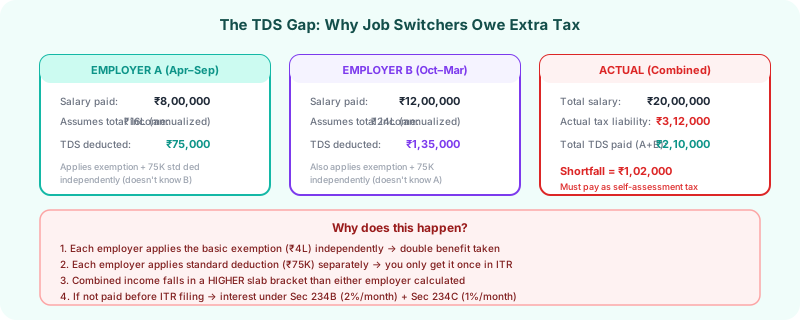
When you switch jobs mid-year, each employer calculates TDS on your salary independently — as though they are your only employer for the entire year. This creates a structural gap between total TDS deducted and actual tax owed on your combined income.
The Root Cause: Duplicate Assumptions
Each employer independently applies the basic exemption limit and standard deduction while computing your TDS. If you work at two companies during FY 2025-26:
- Employer A assumes your total annual income is only what they paid you — applies ₹75,000 standard deduction (New Regime) and the nil-tax slab (₹0–4L) before computing TDS
- Employer B does the exact same thing — again applies the ₹75,000 standard deduction and zero-tax bracket independently
- In reality, you are entitled to the standard deduction and basic exemption only once across your combined salary
⚠️ The TDS Gap in Numbers
Under New Regime, each employer gives you a ₹4,00,000 nil-tax bracket + ₹75,000 standard deduction = ₹4,75,000 of "free" income. With two employers, that's ₹9,50,000 effectively untaxed — but you're only entitled to ₹4,75,000. The excess ₹4,75,000 remains under-taxed, resulting in a shortfall you must pay yourself.
Can you avoid this? Yes — if you declare your previous employer's salary to the new employer (via Form 12B), they can compute TDS on your combined income. But most people either forget or join mid-year without this declaration.
2. How to Consolidate Multiple Form 16s
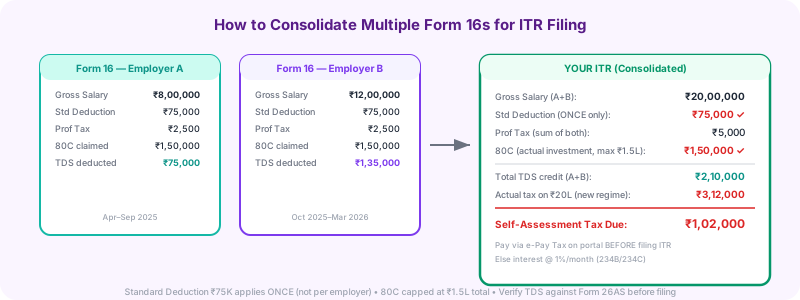
Before computing your actual tax liability, you need to merge the numbers from all Form 16s into a single consolidated view. Here's the correct approach:
Step-by-Step Consolidation
- Gross Salary: Add the gross salary (before any deductions) from Part B of each Form 16. This is your total gross salary for the year.
- Standard Deduction: Apply it only ONCE — ₹75,000 under New Regime or ₹50,000 under Old Regime. Do NOT add the standard deductions shown in each Form 16.
- Professional Tax (Sec 16(iii)): Sum the professional tax deducted by all employers. Each employer can deduct up to ₹2,500/year, so with two employers it could be up to ₹5,000 total. Claim the full sum.
- House Rent Allowance: If under Old Regime, compute HRA exemption for the full year based on actual rent paid and salary for each period separately, then sum the exempt portions.
- Section 80C Deductions: Total investments capped at ₹1,50,000 regardless of how many employers you declared them to. If you declared ₹1.5L to Employer A and again to Employer B, you still get only ₹1.5L total.
- Total TDS: Sum TDS deducted by all employers — this is your total credit available. Verify against Form 26AS/AIS.
| Component | From Employer A | From Employer B | Correct Total |
|---|---|---|---|
| Gross Salary | ₹8,00,000 | ₹12,00,000 | ₹20,00,000 |
| Standard Deduction | ₹75,000 | ₹75,000 | ₹75,000 (once) |
| Professional Tax | ₹2,500 | ₹2,500 | ₹5,000 (sum) |
| 80C Claimed | ₹1,50,000 | ₹1,50,000 | ₹1,50,000 (cap) |
| TDS Deducted | ₹52,000 | ₹1,04,000 | ₹1,56,000 (sum) |
💡 TaxZen auto-consolidates. Upload both Form 16 PDFs and the app merges salary, applies standard deduction once, sums professional tax, and caps 80C correctly — no manual calculation needed.
Important: Always cross-verify your consolidated salary total against your Annual Information Statement (AIS) on the income tax portal. The AIS shows employer-wise salary credited and TDS deposited — any mismatch must be resolved before filing.
3. Calculating the Tax Shortfall
Once you have consolidated numbers, compute the actual tax on your total income and compare it against total TDS already deducted. The difference is your self-assessment tax payable.
New Regime Slabs (AY 2026-27)
| Income Slab | Tax Rate |
|---|---|
| ₹0 – ₹4,00,000 | Nil |
| ₹4,00,001 – ₹8,00,000 | 5% |
| ₹8,00,001 – ₹12,00,000 | 10% |
| ₹12,00,001 – ₹16,00,000 | 15% |
| ₹16,00,001 – ₹20,00,000 | 20% |
| ₹20,00,001 – ₹24,00,000 | 25% |
| Above ₹24,00,000 | 30% |
Worked Example — Two Employers, New Regime
Employer A: Gross Salary ₹8,00,000 (Apr–Sep), TDS deducted ₹26,000
Employer B: Gross Salary ₹12,00,000 (Oct–Mar), TDS deducted ₹78,000
Consolidated:
Total Gross = ₹20,00,000
Standard Deduction = ₹75,000 (once)
Professional Tax = ₹5,000
Taxable Income = ₹20,00,000 − ₹75,000 − ₹5,000 = ₹19,20,000
Tax Computation (New Regime):
₹0–4L = ₹0
₹4–8L = ₹20,000
₹8–12L = ₹40,000
₹12–16L = ₹60,000
₹16–19.2L = ₹64,000
Total Tax = ₹1,84,000
Add 4% Cess = ₹7,360
Total Tax Payable = ₹1,91,360
Total TDS deducted = ₹26,000 + ₹78,000 = ₹1,04,000
Shortfall = ₹1,91,360 − ₹1,04,000 = ₹87,360
Why is the gap so large? Each employer assumed you fell in a lower slab. Employer A computed tax as if ₹8L was your annual income (mostly in the 5% bracket). Employer B did the same for ₹12L. But your combined ₹19.2L taxable income pushes you into the 20% bracket — neither employer accounted for this.
4. How to Pay Self-Assessment Tax
The shortfall amount must be paid as self-assessment tax before filing your ITR. If you file without paying, the return will be flagged as defective.
Steps to Pay via e-Pay Tax (Portal)
⚠️ Note: The old Challan 280 / NSDL portal has been discontinued. All payments are now made directly on the Income Tax e-Filing portal.
- Login to incometax.gov.in
- Go to e-File → e-Pay Tax → New Payment
- Select Assessment Year: 2026-27
- Under "Type of Payment", choose (300) Self Assessment Tax
- Enter the tax amount (shortfall computed above) in the "Tax" field. Leave Surcharge, Cess, and Interest as 0 — the portal handles the breakup automatically
- Choose payment mode: Net Banking, Debit Card, UPI, or Payment Gateway
- Complete payment and save the BSR code, challan serial number, and date from the receipt
Timing matters: Pay self-assessment tax before filing your ITR. The challan details (BSR code, serial number, date, amount) must be entered in the ITR form. Payment reflects in your 26AS within 3–5 working days.
Include interest if applicable: If you owe advance tax interest under Sec 234B or 234C (covered in Section 6 below), add it to your self-assessment payment. The ITR portal will auto-compute interest during processing — paying it upfront avoids demand notices.
5. Filing ITR with Multiple Employers
Having multiple Form 16s doesn't change which ITR form you use — that depends on your total income and income types.
Which ITR Form?
| Condition | Form |
|---|---|
| Total income ≤ ₹50 lakh, only salary + one house property + other sources | ITR-1 (Sahaj) |
| Total income > ₹50 lakh, OR capital gains, OR foreign assets | ITR-2 |
Most salaried job switchers with combined income under ₹50L will file ITR-1. Multiple employers doesn't require ITR-2 by itself.
Entering Salary Details in Schedule S
- On the ITR portal, go to Schedule S (Salary)
- Add each employer separately — enter the TAN, employer name, and salary details from that Form 16
- For each employer, enter: Gross Salary, Allowances Exempt u/s 10, Perquisites, Professional Tax deducted, and TDS amount
- The portal will sum salary from all employers automatically
- Under "Deductions from Salary", the portal applies standard deduction only once on the total
Schedule TDS: Enter TDS details for each employer separately in Schedule TDS1 (from salary). Include the TAN, employer name, total income under that TAN, and TDS deducted. These must match your Form 26AS exactly — mismatches trigger Sec 143(1) notices.
⚠️ Sec 143(1) Intimation: This is the most common notice received by job switchers. It's an automated processing intimation where the CPC (Centralized Processing Centre) re-computes your tax. If your salary figures or TDS don't match Form 26AS/AIS, you'll receive a demand notice. Always reconcile before filing.
6. Avoiding Interest and Penalties
If your tax shortfall (after TDS) exceeds ₹10,000 in a financial year, you were technically required to pay advance tax in quarterly installments. Failing to do so attracts interest — even if you pay the full amount at the time of filing.
Section 234B — Default on Advance Tax
- Applies when you pay less than 90% of assessed tax as advance tax during the year
- Interest: 1% per month (simple interest) on the shortfall amount
- Charged from 1 April of the assessment year until the date you actually pay
- Even one day in a month counts as a full month for interest calculation
Section 234C — Deferment of Advance Tax
- Applies when you miss the quarterly advance tax deadlines (15 Jun, 15 Sep, 15 Dec, 15 Mar)
- Interest: 1% per month for 3 months on the shortfall for each quarter
- Calculated on the difference between what should have been paid cumulatively and what was actually paid
| Quarter Due Date | Cumulative % Due | Action for Job Switchers |
|---|---|---|
| 15 June | 15% | Usually still at first employer — no action needed |
| 15 September | 45% | If you switched mid-year, estimate shortfall and pay |
| 15 December | 75% | Calculate gap using both salary figures, pay advance tax |
| 15 March | 100% | Final installment — pay remaining shortfall before year-end |
Pro tip: If you switch jobs in the second half of the year (Oct–Mar), you still have time to pay advance tax by 15 December or 15 March. This avoids 234B/234C interest entirely. Use TaxZen to estimate your shortfall the moment you receive your first payslip from the new employer.
Note: Salaried individuals whose entire tax liability is covered by TDS are exempt from advance tax. The ₹10,000 threshold applies to tax liability after subtracting all TDS. If your combined TDS from both employers covers 90%+ of your actual tax, 234B does not apply.
7. Common Mistakes to Avoid
Claiming standard deduction twice
Each Form 16 shows standard deduction separately, but you can claim it only once on your combined salary. ₹75,000 total under New Regime, not ₹75,000 per employer.
Double-claiming Section 80C investments
If you declared ₹1.5L of investments to both employers, the total deduction is still capped at ₹1.5L — not ₹3L. The IT department will catch this mismatch.
Using only one Form 16 and ignoring the other
ALL salary income must be reported. The IT department has TDS data from both employers via 26AS/AIS. Omitting one employer's income will trigger a mismatch notice.
Not verifying TDS against Form 26AS
TDS credit is given based on what's reflected in 26AS, not what your Form 16 says. If an employer deposited TDS late, it may not appear. Always verify before filing.
Filing without paying self-assessment tax first
The ITR will be processed as defective if there's a tax shortfall without a corresponding challan payment. Always pay via e-File → e-Pay Tax on incometax.gov.in before submitting your return.
Entering wrong TAN for an employer
TDS credit is matched by TAN. If you enter the wrong TAN in Schedule TDS, the credit won't be mapped and you'll face a demand for the full tax amount. Copy TAN exactly from Form 16 Part A.
Ignoring overlap period salary
If you received salary from both employers in the same month (notice period buy-out, joining bonus paid early), ensure both amounts are captured. Check your bank statement against Form 16 totals.
Not paying advance tax when shortfall exceeds ₹10,000
Interest under 234B/234C is charged retroactively from the quarter the tax was due. Even if you pay everything at filing time, interest accrues from the original due dates.
Choosing wrong regime inconsistently
You must file under the same tax regime for the entire year. If Employer A deducted TDS under Old Regime and Employer B under New, reconcile at filing time — you choose ONE regime for the full year's computation.
Let TaxZen handle the complexity
Upload your Form 16s from all employers — we auto-consolidate salary, compute the exact shortfall, and generate ITR-ready figures. No spreadsheets, no manual slab calculations.
Consolidate My Form 16s Free →Frequently Asked Questions
Can I claim standard deduction from both employers?
Why do job switchers get tax notices?
Do I need to pay self-assessment tax before filing ITR?
Can I file ITR-1 with two Form 16s?
What is the interest rate for not paying advance tax?
Related Guides
Disclaimer: This guide is for educational purposes only and does not constitute tax, legal, or financial advice. Tax computation depends on individual facts and circumstances including applicable regime, exemptions claimed, and employer declarations. Always verify computations with a qualified Chartered Accountant before filing. Tax rates and rules as per Finance Act 2025 applicable for AY 2026-27. Self-assessment tax must be paid before filing ITR to avoid defective return status.