
How to File ITR for RSU / ESOP Income in India
Complete guide for AY 2026-27 (FY 2025-26) — Schedule CG, Schedule FA, currency conversion & portal filing steps
Last updated: July 2026 • 12 min read
Calculate your RSU tax for free
Upload Form 16 → enter RSU sales → get exact amounts to file
Table of Contents
- The two-stage tax — how RSUs are taxed in India
- Tax at vesting (perquisite in Form 16)
- Capital gains when you sell
- USD → INR conversion: SBI TT Buying Rate
- How to fill Schedule CG on the portal
- Schedule FA — foreign asset disclosure
- Dividends & Foreign Tax Credit (Form 67)
- Where to get your data (E-Trade, Fidelity, Schwab)
- Filing checklist
- Common mistakes to avoid
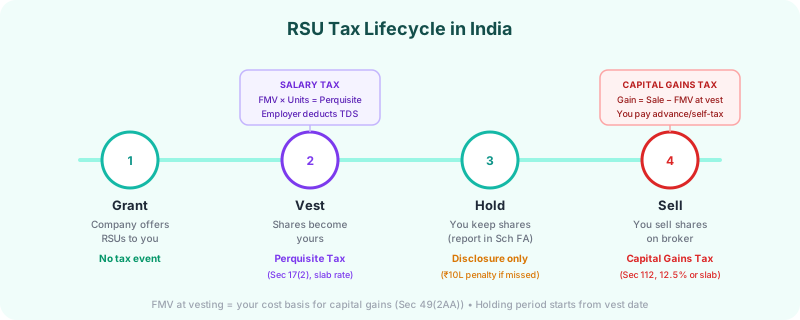
1. The Two-Stage Tax — How RSUs Are Taxed in India
If you are an Indian resident holding RSUs from a US or foreign company, your shares are taxed twice over their lifetime:
| Stage | When | Taxed As | Rate |
|---|---|---|---|
| 1. Vesting | Day shares become yours | Salary perquisite (Sec 17(2)(vi)) | Your slab rate (employer deducts TDS) |
| 2. Sale | When you sell shares | Capital gains (STCG or LTCG) | Slab rate (STCG) or 12.5% (LTCG) |
Additionally, dividends are taxed as "Income from Other Sources" and Schedule FA disclosure is mandatory every year you hold foreign shares — regardless of whether you sold any.
2. Tax at Vesting — The Perquisite
On the vesting date, the Fair Market Value (FMV) of the shares is treated as a perquisite and added to your salary. Your employer deducts TDS on this amount (usually through "sell-to-cover").
Worked Example
100 shares vest at FMV of $50 each. SBI TT Rate = ₹83/$.
Perquisite = 100 × $50 × ₹83 = ₹4,15,000 — added to salary, TDS deducted by employer.
If 30 shares are sold-to-cover for TDS, you keep 70 shares with cost basis = ₹4,150/share.
Key point: Under Section 49(2AA), the FMV taxed as perquisite becomes your cost of acquisition for future capital gains calculation. You only pay CG tax on gains above the vesting-day FMV.
This perquisite already appears in your Form 16 / Form 12BA. You don't need to report it separately — just verify it matches your broker's vesting statement.
3. Capital Gains When You Sell
When you sell the shares you kept, capital gains = Sale Price − Cost of Acquisition (FMV at vesting).
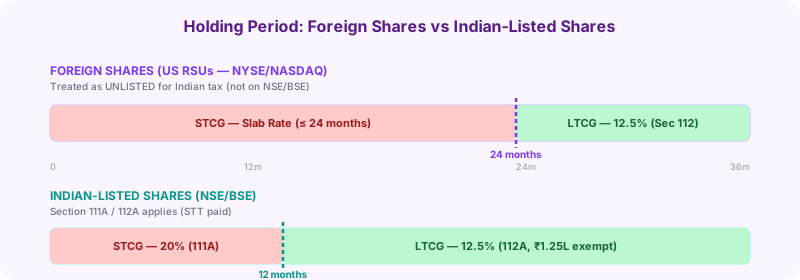
⚠️ Critical: Foreign shares = Unlisted Securities
US shares (NYSE/NASDAQ) that are NOT listed on NSE/BSE are treated as unlisted securities for Indian tax purposes. This means a 24-month holding period for LTCG — not 12 months. Also, the ₹1.25L LTCG exemption (Section 112A) does NOT apply to foreign shares.
| Holding Period (from vesting date) | Type | Tax Rate | Section |
|---|---|---|---|
| ≤ 24 months | Short-Term (STCG) | Your slab rate | Normal provisions |
| > 24 months | Long-Term (LTCG) | 12.5% (no indexation) | Section 112 |
Worked Example
Sell 70 shares 30 months after vesting at $90/share. SBI TT Rate on sale date = ₹85/$.
Sale value = 70 × $90 × ₹85 = ₹5,35,500
Cost = 70 × ₹4,150 = ₹2,90,500
LTCG = ₹2,45,000 → Tax @ 12.5% = ₹30,625 + surcharge + 4% cess
Surcharge note: Surcharge on LTCG under Section 112 is capped at 15%, even for high earners. This cap does NOT apply to STCG (slab rate), which can attract higher surcharge.
4. USD → INR Conversion: SBI TT Buying Rate
The Rule
Convert all foreign amounts to INR using the SBI Telegraphic Transfer (TT) Buying Rate as on the last day of the month preceding the month of the transaction.
Example: Sold shares on 15 July 2025 → Use SBI TT rate on 30 June 2025.
Find historical SBI TT rates at: sbi.co.in/web/forex-rates
You need to convert both the vesting-day FMV (for cost basis) and the sale price to INR using this method.
5. How to Fill Schedule CG on the Portal
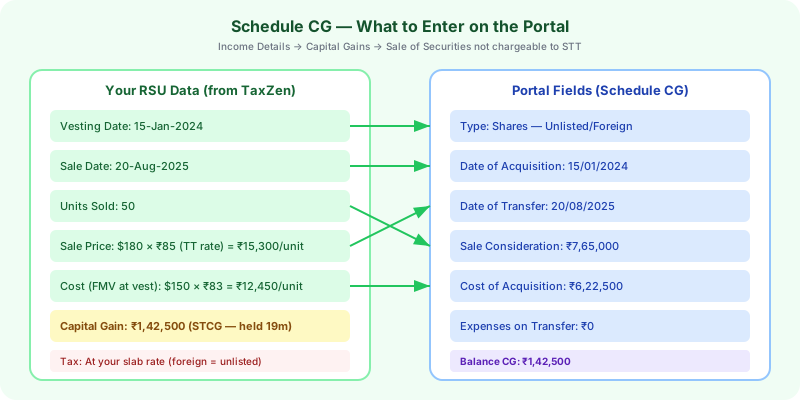
On the income tax portal, navigate to:
For each RSU sale transaction, enter:
- Type of asset: Shares and Securities (Unlisted / Foreign)
- Date of acquisition: Vesting date (NOT grant date)
- Date of sale: Actual sale date
- Sale consideration: Sale price × units × SBI TT rate (in INR)
- Cost of acquisition: FMV on vesting date × units × SBI TT rate (in INR)
- Expenses on transfer: Brokerage + STT (if any)
💡 TaxZen auto-calculates all these values. Use the RSU step in TaxZen to enter your vesting/sale details, and the Draft Review page shows the exact amounts to type into each portal field.
6. Schedule FA — Foreign Asset Disclosure
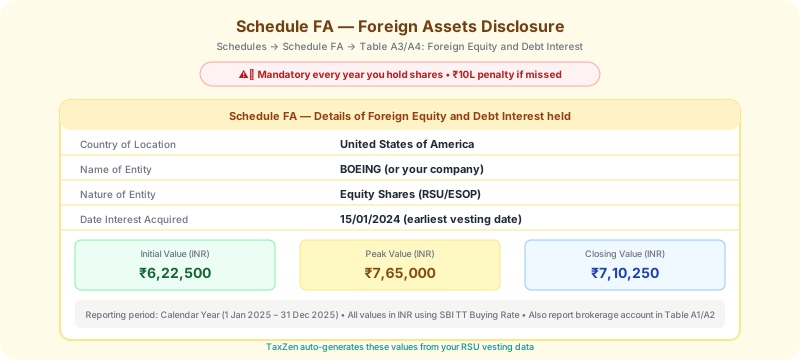
⚠️ Penalty for non-disclosure: ₹10 lakh per year
Under the Black Money Act 2015, failing to report foreign assets attracts a flat ₹10 lakh penalty — regardless of whether any tax was due.
Key Rules
- Who must file: Resident and Ordinarily Resident (ROR) individuals only
- Calendar year reporting: Uses Jan–Dec (not Apr–Mar). For AY 2026-27, report 1 Jan 2025 – 31 Dec 2025
- No minimum threshold: Even 1 share for 1 day must be reported
- ITR-2 mandatory: Foreign shares make ITR-1 ineligible
- Report even if unsold: Every year from vesting until year of sale
Portal Fields
Navigate to: Schedules → Schedule FA → Table A3/A4
| Field | What to Enter |
|---|---|
| Country | United States of America |
| Name of Entity | Company name (BOEING, GOOGLE, etc.) |
| Nature | Equity Shares (RSU/ESOP) |
| Date Acquired | Earliest vesting date |
| Initial Value | FMV at vesting × SBI TT rate |
| Peak Value | Highest price during CY × units × rate |
| Closing Value | Price on 31 Dec × remaining units × rate |
7. Dividends & Foreign Tax Credit
US companies withhold 25% tax on dividends (with W-8BEN filed). In India, report the gross dividend as Other Income and claim a Foreign Tax Credit.
Steps
- File Form 67 on the portal (deadline: 31 Mar 2027 for AY 2026-27)
- Schedule OS: Report gross dividend as Income from Other Sources
- Schedule FSI: Report foreign source income + foreign tax paid
- Schedule TR: Claim the credit (lower of US tax or Indian tax on same income)
Note: The correct DTAA rate for individuals is 25% (Article 10, India-US DTAA). The 15% rate applies only to corporate shareholders with ≥10% voting stock.
8. Where to Get Your Data
Download your Gain & Loss statement. You need: Vesting Date, Sale Date, Quantity, Sale Price, FMV at Vesting.
E-Trade
Accounts → At Work → Tax Information → Gains & Losses → Date range → Download Expanded
Fidelity
Statements and Records → Custom Transaction Summary → Date range → Download PDF
Charles Schwab
Accounts → Documents → Statements → Account Statement for full FY
Morgan Stanley
Activity → Reports → Set dates → View as PDF → Full Account Summary
Equate Plus
Library → Transactions → Select year → Export (amounts in EUR — convert with SBI TT rate)
9. Filing Checklist
- ☐ Confirm residency status (ROR/RNOR/NR)
- ☐ File ITR-2 (never ITR-1 with foreign shares)
- ☐ Verify perquisite in Form 16 matches broker vesting statement
- ☐ Report holdings in Schedule FA (calendar year Jan–Dec 2025)
- ☐ Report sales in Schedule CG — 24-month test from vesting date
- ☐ Convert amounts using SBI TT Buying Rate (last day of preceding month)
- ☐ Report dividends in Schedule OS (gross, before US withholding)
- ☐ File Form 67 + Schedules FSI & TR for Foreign Tax Credit
- ☐ Report foreign brokerage account in Schedule FA (even if zero balance)
- ☐ Keep: vesting statements, Form 1042-S, broker G&L, conversion papers
10. Common Mistakes to Avoid
Using 12-month holding period for foreign shares
Foreign = unlisted → LTCG only after 24 months.
Using cost basis = ₹0 or grant-date price
Cost = FMV on vesting date (Sec 49(2AA)).
Claiming ₹1.25L LTCG exemption on foreign shares
That's Section 112A only (Indian-listed, STT-paid). Foreign = Section 112, taxable from ₹1.
Skipping Schedule FA
₹10L penalty. India gets foreign account data automatically — mismatches trigger notices.
Using Google exchange rate instead of SBI TT rate
Law requires SBI TT Buying Rate on last day of preceding month.
Filing ITR-1 while holding foreign shares
Any foreign asset → ITR-2 mandatory, even if no sale or income.
Let TaxZen handle the numbers
Upload Form 16, enter RSU details, and get exact amounts for Schedule CG + Schedule FA. Free, no account needed.
Calculate My RSU Tax Free →Frequently Asked Questions
Are US RSUs taxed twice in India?
What is the holding period for foreign RSU shares?
Is Schedule FA mandatory even if I didn't sell any RSU shares?
Which exchange rate should I use to convert USD to INR for RSU tax?
Can I file ITR-1 if I have RSU shares?
Related Guides
💹Capital Gains Filing Guide
STCG/LTCG rates, Schedule CG, broker P&L import, property gains
15 min read
₿Crypto & VDA Tax Guide
Flat 30% tax, Schedule VDA, TDS 194S, no loss set-off
14 min read
🔄Multiple Form 16 / Job Switch Guide
Consolidate salary, TDS shortfall, e-Pay Tax, avoid 234B interest
12 min read
Disclaimer: This guide is for educational purposes only and does not constitute tax, legal, or financial advice. RSU taxation is fact-specific. Verify with a qualified CA before filing. Rates for FY 2025-26 (AY 2026-27) per Budget 2024/2025.