
How to File Crypto & VDA Tax in India — Complete Guide AY 2026-27
Section 115BBH flat 30% tax, Schedule VDA walkthrough, TDS credit, exchange data import & common mistakes — all in one place
Last updated: July 2026 • 14 min read
Compute your crypto/VDA tax for free
Upload exchange data → get exact Schedule VDA amounts to file
Table of Contents
1. How Crypto is Taxed in India (Section 115BBH)
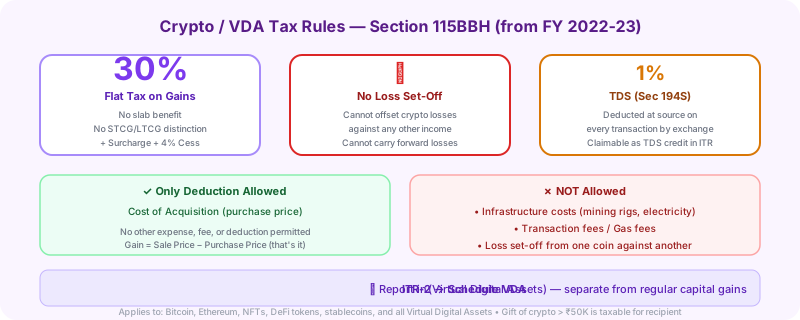
Since 1 April 2022, all crypto and Virtual Digital Assets (VDA) — including Bitcoin, Ethereum, altcoins, NFTs, and DeFi tokens — are taxed under Section 115BBH of the Income Tax Act at a flat 30% rate. There is no distinction between short-term and long-term gains for crypto.
| Rule | Detail |
|---|---|
| Tax Rate | Flat 30% on all gains (+ 4% cess + surcharge if applicable) |
| STCG/LTCG distinction | None — always 30% regardless of holding period |
| Slab benefit | Not available — 30% even if total income is below basic exemption |
| Deductions allowed | Only cost of acquisition (purchase price). No other expenses, no 80C/80D |
| Loss set-off | NOT allowed — crypto losses cannot offset any income (not even other crypto gains) |
| Loss carry-forward | NOT allowed — losses expire in the same year |
| TDS | 1% TDS under Section 194S deducted by buyer/exchange on every transfer |
| ITR Form | ITR-2 (or ITR-3 if you have business income) with Schedule VDA |
⚠️ No Loss Set-Off — The Harshest Rule
If you made ₹5L profit on Bitcoin but lost ₹3L on an altcoin, you cannot offset the loss. You pay 30% tax on ₹5L (= ₹1.5L tax) and the ₹3L loss simply vanishes. This applies to losses from different VDAs — each transaction is taxed independently.
What qualifies as VDA? Any crypto/token (Bitcoin, ETH, USDT, meme coins), NFTs, DeFi LP tokens, wrapped tokens, stablecoins — essentially any digital asset using cryptography on a distributed ledger. Even in-game tokens and metaverse assets are VDA.
2. What Counts as a Taxable Event
Not just selling for INR — many crypto actions trigger a tax liability. Here's the complete list:
Selling crypto for INR (fiat)
The most obvious event — selling Bitcoin/ETH for rupees on any exchange. 30% tax on gain.
Swapping one crypto for another
Converting BTC to ETH, or any token-to-token swap (including stablecoin swaps like USDT→USDC) is a taxable transfer. The sale value is the market price of what you received.
Spending crypto to buy goods/services
Paying with crypto (e.g., buying a gift card with BTC) is treated as a sale at the market value at the time of spending.
Gifting crypto (value > ₹50,000)
The recipient is taxed on the market value as "Income from Other Sources" if total gifts exceed ₹50,000 in a year. The giver has no tax event (but TDS may still apply on transfer).
Staking rewards received
Staking rewards (PoS) are taxed as "Income from Other Sources" at your slab rate when received. The FMV at receipt becomes your cost of acquisition. If you later sell, the gain is taxed at 30%.
Airdrops and mining rewards
Same as staking — taxed at slab rate as "Income from Other Sources" when received. Cost of acquisition = FMV at time of receipt. Subsequent sale → 30% on gain above that cost.
NOT taxable: Simply buying crypto with INR and holding (no transfer). Transferring between your own wallets (same person, same asset) is not a taxable event.
DeFi note: Providing liquidity, wrapping/unwrapping tokens, and yield farming harvests likely constitute taxable transfers. The exact treatment is evolving — err on the side of reporting every token movement that changes your economic position.
3. Schedule VDA on the Portal — Field-by-Field Walkthrough
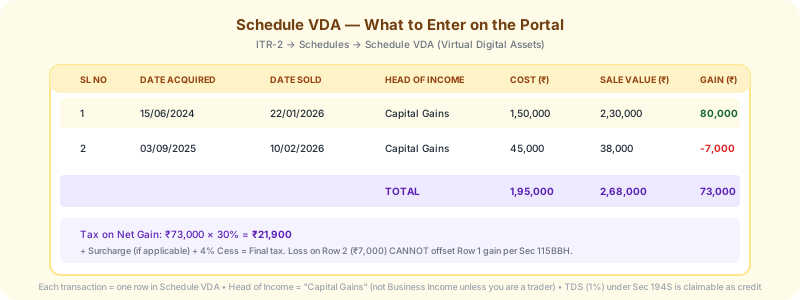
Crypto/VDA gains are reported in Schedule VDA of ITR-2 (or ITR-3). You need to add one row per transaction (or group identical transactions). Here are the fields:
| Field | What to Enter |
|---|---|
| Type of VDA | Select from dropdown: Cryptocurrency / NFT / Other |
| Date of Transfer | Date you sold/swapped/spent the VDA (DD/MM/YYYY) |
| Date of Acquisition | Date you originally bought/received the VDA |
| Head under which income offered | Select: "Capital Gains" (for buy-and-sell) or "Income from Other Sources" (for mining/staking/airdrops) |
| Cost of Acquisition | Purchase price in INR. For airdrops/mining = FMV at receipt. For gifted VDA = cost to giver (or zero if unknown) |
| Consideration Received / Accruing | Sale value in INR. For swaps = FMV of token received. For spending = market value of goods/services |
| Income from transfer of VDA | Auto-calculated: Consideration − Cost of Acquisition (the portal computes this) |
💡 Bulk entry tip
If you have hundreds of trades, the IT portal allows CSV upload for Schedule VDA (select "Upload CSV" option in Schedule VDA section). Most exchanges provide data in the required format. For many small trades of the same coin, you can aggregate them by date range.
💡 TaxZen auto-fills Schedule VDA. Upload your exchange trade history and the app generates exact portal-ready field values for every transaction — correctly handling swaps, airdrops, and cost basis.
4. How to Calculate Crypto Gains
The calculation is deliberately simple (and harsh). Unlike capital gains on equity, you get no deductions other than cost of acquisition:
That's it. No brokerage, no gas fees, no exchange fees, no transfer charges — only the purchase price is deductible.
What counts as "Cost of Acquisition"?
- Bought on exchange: INR amount paid to buy the crypto (excl. fees)
- Received as airdrop/mining: FMV in INR on the date you received it (which was already taxed as other income)
- Received as gift: Cost to the person who gave it to you
- Bought via P2P: Actual INR paid to the seller
- Cost unknown / not determinable: Treated as ZERO — you pay 30% on full sale value
Worked Example
Bought 0.5 BTC at ₹12,00,000 on 15 Jan 2025.
Sold 0.5 BTC for ₹18,00,000 on 10 Nov 2025.
Sale Value = ₹18,00,000
Cost of Acquisition = ₹12,00,000
Taxable Gain = ₹18,00,000 − ₹12,00,000 = ₹6,00,000
Tax = ₹6,00,000 × 30% = ₹1,80,000
+ 4% Cess = ₹7,200
Total tax payable = ₹1,87,200
Swap Example
Bought 10 ETH at ₹80,000 each (cost = ₹8,00,000).
Swapped 10 ETH for 50,000 USDT when ETH = ₹1,20,000 each.
Consideration = 10 × ₹1,20,000 = ₹12,00,000 (FMV at time of swap)
Cost = ₹8,00,000
Taxable Gain = ₹12,00,000 − ₹8,00,000 = ₹4,00,000
Tax = ₹4,00,000 × 30% = ₹1,20,000 + cess
The 50,000 USDT now has a cost basis of ₹12,00,000 for future sales.
⚠️ Remember: No set-off between coins
If you made ₹4L gain on ETH and ₹2L loss on DOGE in the same year, you pay 30% on ₹4L. The DOGE loss cannot reduce your ETH gain. Each profitable transaction is taxed independently.
5. TDS on Crypto (Section 194S)
Since 1 July 2022, a 1% TDS is deducted on every crypto transfer above ₹50,000/year (₹10,000 for specified persons). Indian exchanges automatically deduct this on every sell/swap.
| Parameter | Detail |
|---|---|
| TDS Rate | 1% of total sale consideration (not just profit) |
| Who deducts | The exchange (WazirX, CoinDCX, etc.) or the buyer in P2P trades |
| Threshold | ₹50,000/year for regular persons; ₹10,000 for specified persons (those with business/professional income > ₹1Cr / ₹50L) |
| Applies to | All transfers — sell for INR, crypto-to-crypto swaps, spending |
| Claiming credit | Claim full TDS credit in ITR under "TDS on Sale of Virtual Digital Assets" (Schedule TDS2) |
| Refund | If TDS > actual tax liability, the excess is refunded after ITR processing |
Example: TDS on a ₹5L sale
You sell crypto worth ₹5,00,000 on WazirX.
TDS deducted = 1% × ₹5,00,000 = ₹5,000
You receive ₹4,95,000 in your exchange wallet.
In your ITR, report the full ₹5L as consideration and claim ₹5,000 as TDS credit. The ₹5,000 reduces your final tax payable.
How to verify TDS: Check your Form 26AS or AIS on the income tax portal. All crypto TDS deducted by exchanges should appear under Section 194S. If any TDS is missing, raise it with the exchange — unmatched TDS cannot be claimed.
6. How to Get Data from Exchanges
You need your complete trade history to fill Schedule VDA. Here's how to download from popular exchanges:
WazirX
- Log in to WazirX web (wazirx.com)
- Go to Funds → Transaction History
- Select date range: 1 Apr 2025 to 31 Mar 2026
- Click "Export" → select CSV format
- Also download TDS Certificate from Settings → Tax Reports for 194S details
CoinDCX
- Log in to CoinDCX web
- Navigate to Reports → Tax Reports
- Select financial year: FY 2025-26
- Download the "Tax Report" — it includes gain/loss per transaction
- Also download TDS statement separately from Reports → TDS
Binance
- Log in to Binance web or app
- Go to Orders → Transaction History → Generate All Statements
- Select Custom → 1 Apr 2025 to 31 Mar 2026
- Request "Generate" — the report is emailed to you within a few hours
- Note: Binance does not deduct TDS (non-Indian exchange). You must self-report all gains and pay advance tax
Zebpay
- Log in to Zebpay app
- Go to Profile → Transaction History
- Select date range for FY 2025-26
- Tap "Download Statement"
- TDS details available in Profile → Tax Reports → TDS Certificate
International exchanges (Binance, Bybit, OKX, etc.): These do not deduct TDS. If you trade on non-Indian exchanges, you are responsible for computing and paying advance tax yourself. Failure to do so can result in interest under Sec 234B/234C.
DeFi / DEX trades: For Uniswap, PancakeSwap, Aave, etc., there is no centralized report. You'll need to use your wallet address and a blockchain explorer (Etherscan, BscScan) or a crypto tax aggregator to reconstruct your trade history with INR values.
7. Common Mistakes to Avoid
Setting off crypto losses against other crypto gains
Under Sec 115BBH, losses from one VDA CANNOT be set off against gains from another VDA. Each profitable transfer is taxed at 30% independently.
Deducting exchange fees, gas fees, or brokerage from gains
Only the cost of acquisition (purchase price) is deductible. Transaction fees, withdrawal fees, gas fees, and network charges are NOT deductible.
Not reporting crypto-to-crypto swaps
Every swap (BTC→ETH, ETH→USDT, token→token) is a taxable transfer. Many people think only INR withdrawals are taxed — this is wrong.
Filing ITR-1 or ITR-4 with crypto income
Crypto/VDA income requires ITR-2 (salaried) or ITR-3 (business). ITR-1 and ITR-4 do not have Schedule VDA.
Not reporting airdrops or staking rewards
Even "free" tokens are taxable as income from other sources at the time of receipt. The FMV at receipt becomes your cost basis for future sales.
Ignoring international exchange transactions
Gains on Binance, Bybit, or any foreign exchange are fully taxable in India. The IT department can track via international data exchange agreements. Non-reporting can lead to notices.
Not paying advance tax on crypto gains
If your total tax liability exceeds ₹10,000 in a year, you must pay advance tax in quarterly installments. Missing this attracts interest under Sec 234B/234C.
Claiming crypto losses as carry-forward
Unlike capital losses on equity, crypto/VDA losses cannot be carried forward to future years. They expire in the year they occur.
Missing TDS credit (₹0 refund)
Indian exchanges deduct 1% TDS on every sale. If you don't claim this in your ITR (Schedule TDS2), you lose the credit. Always verify against Form 26AS/AIS.
Treating NFT sales differently from crypto
NFTs are classified as VDA and follow the exact same 30% tax rules. No special treatment, no exemptions.
Let TaxZen compute your crypto tax
Upload your exchange trade history → get exact Schedule VDA entries, 30% tax computed, and TDS credit mapped. Free, no account needed.
Compute My Crypto Tax Free →Frequently Asked Questions
Can I set off crypto losses against crypto gains from a different coin?
Is swapping one crypto for another a taxable event?
How does the 1% TDS on crypto work?
Are staking rewards and airdrops taxable?
Which ITR form do I use for crypto income?
Related Guides
📈RSU / ESOP Filing Guide
Schedule CG, Schedule FA, SBI TT rate, 24-month holding period
12 min read
💹Capital Gains Filing Guide
STCG/LTCG rates, Schedule CG, broker P&L import, property gains
15 min read
🔄Multiple Form 16 / Job Switch Guide
Consolidate salary, TDS shortfall, e-Pay Tax, avoid 234B interest
12 min read
Disclaimer: This guide is for educational purposes only and does not constitute tax, legal, or financial advice. Crypto/VDA taxation depends on individual facts and circumstances. The Income Tax Department's interpretation of DeFi, staking, and airdrops may evolve. Verify with a qualified CA before filing. Tax rules as per Finance Act 2022 (Section 115BBH & 194S) applicable from AY 2023-24 onwards, rates confirmed for AY 2026-27.