
Old vs New Tax Regime 2026 — Which Saves More?
Complete slab comparison, breakeven analysis, deductions lost & retained, lock-in rules, and a simple decision matrix
Last updated: July 2026 • 12 min read
Compare both regimes for your exact salary
Enter income & deductions → see which regime saves you more tax
Table of Contents
1. New Regime Slabs (AY 2026-27)
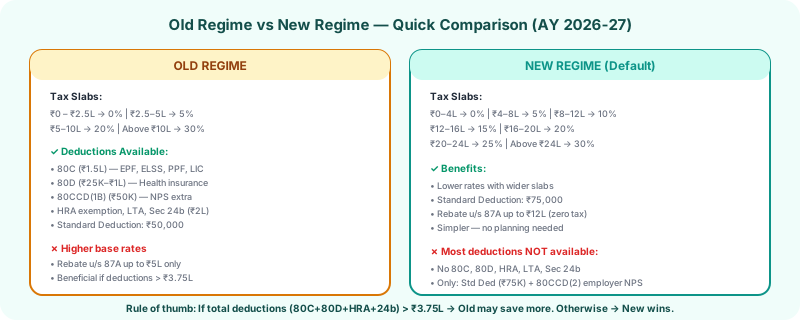
The new tax regime under Section 115BAC is the default regime from AY 2024-25 onwards. For AY 2026-27, the slabs have been revised with wider brackets and a higher rebate threshold:
| Taxable Income Slab | Tax Rate |
|---|---|
| Up to ₹4,00,000 | Nil (0%) |
| ₹4,00,001 – ₹8,00,000 | 5% |
| ₹8,00,001 – ₹12,00,000 | 10% |
| ₹12,00,001 – ₹16,00,000 | 15% |
| ₹16,00,001 – ₹20,00,000 | 20% |
| ₹20,00,001 – ₹24,00,000 | 25% |
| Above ₹24,00,000 | 30% |
Standard Deduction: ₹75,000 for salaried individuals and pensioners under the new regime.
Rebate u/s 87A: If your total income (after standard deduction) is up to ₹12,00,000, the entire tax liability is wiped out via rebate. Effectively, salaried individuals earning up to ₹12,75,000 pay zero tax under the new regime.
2. Old Regime Slabs
The old regime retains the traditional slab structure with fewer brackets but allows the full suite of deductions and exemptions:
| Taxable Income Slab | Tax Rate |
|---|---|
| Up to ₹2,50,000 | Nil (0%) |
| ₹2,50,001 – ₹5,00,000 | 5% |
| ₹5,00,001 – ₹10,00,000 | 20% |
| Above ₹10,00,000 | 30% |
Standard Deduction: ₹50,000 for salaried individuals and pensioners under the old regime.
Rebate u/s 87A: If total taxable income is up to ₹5,00,000, the tax liability (up to ₹12,500) is rebated. Effectively zero tax up to ₹5L income under old regime.
3. Which Deductions You Lose in New Regime
The new regime offers lower tax rates but strips away nearly all deductions and exemptions. Here's what you cannot claim under the new regime:
| Deduction / Exemption | Max Amount | New Regime |
|---|---|---|
| Section 80C (PPF, ELSS, LIC, EPF) | ₹1,50,000 | ✗ Not allowed |
| Section 80D (Health Insurance) | ₹25,000 – ₹1,00,000 | ✗ Not allowed |
| HRA Exemption (Sec 10(13A)) | Varies | ✗ Not allowed |
| LTA (Leave Travel Allowance) | Varies | ✗ Not allowed |
| Section 24(b) — Home Loan Interest | ₹2,00,000 | ✗ Not allowed |
| Section 80E (Education Loan Interest) | No limit | ✗ Not allowed |
| Section 80G (Donations) | Varies | ✗ Not allowed |
What You Still Get in New Regime
| Deduction | Details | New Regime |
|---|---|---|
| Standard Deduction | ₹75,000 for salaried / pensioners | ✓ Allowed |
| Section 80CCD(2) — Employer NPS | Up to 14% of salary (Govt) / 10% (Private) | ✓ Allowed |
| Section 80JJAA | New employee hiring deduction | ✓ Allowed |
Key takeaway: If your only deductions are standard deduction and employer NPS contribution, the new regime is almost certainly better. You need substantial deductions (80C + 80D + HRA + home loan) to make old regime worthwhile.
4. The Breakeven Rule: When Old Regime Wins
The general rule: if your total deductions (80C + 80D + HRA + Sec 24b + others) exceed approximately ₹3.75 lakh, the old regime starts saving more tax — especially at salary levels of ₹15L and above.
Below that threshold, the new regime's lower slab rates and higher rebate make it the winner. Let's see worked examples:
Worked Example: Gross Salary ₹10,00,000
New Regime
Gross: ₹10,00,000
Less Std Ded: ₹75,000
Taxable: ₹9,25,000
Tax: ₹4L×0% + ₹4L×5% + ₹1.25L×10%
= ₹0 + ₹20,000 + ₹12,500 = ₹32,500
+ 4% cess = ₹33,800
Old Regime (with ₹2.5L deductions)
Gross: ₹10,00,000
Less Std Ded: ₹50,000
Less 80C+80D: ₹2,50,000
Taxable: ₹7,00,000
Tax: ₹2.5L×0% + ₹2.5L×5% + ₹2L×20%
= ₹0 + ₹12,500 + ₹40,000 = ₹52,500
+ 4% cess = ₹54,600
→ New regime saves ₹20,800 at ₹10L salary with ₹2.5L deductions
Worked Example: Gross Salary ₹15,00,000
New Regime
Gross: ₹15,00,000
Less Std Ded: ₹75,000
Taxable: ₹14,25,000
Tax: ₹4L×0% + ₹4L×5% + ₹4L×10% + ₹2.25L×15%
= ₹0 + ₹20,000 + ₹40,000 + ₹33,750 = ₹93,750
+ 4% cess = ₹97,500
Old Regime (with ₹4L deductions)
Gross: ₹15,00,000
Less Std Ded: ₹50,000
Less 80C+80D+HRA: ₹4,00,000
Taxable: ₹10,50,000
Tax: ₹2.5L×0% + ₹2.5L×5% + ₹5L×20% + ₹0.5L×30%
= ₹0 + ₹12,500 + ₹1,00,000 + ₹15,000 = ₹1,27,500
+ 4% cess = ₹1,32,600
→ New regime saves ₹35,100 at ₹15L salary with ₹4L deductions
Old regime wins only if total deductions exceed ₹5.25L+ at this salary level
Worked Example: Gross Salary ₹20,00,000
New Regime
Gross: ₹20,00,000
Less Std Ded: ₹75,000
Taxable: ₹19,25,000
Tax: ₹4L×0% + ₹4L×5% + ₹4L×10% + ₹4L×15% + ₹3.25L×20%
= ₹0 + ₹20,000 + ₹40,000 + ₹60,000 + ₹65,000 = ₹1,85,000
+ 4% cess = ₹1,92,400
Old Regime (with ₹5L deductions)
Gross: ₹20,00,000
Less Std Ded: ₹50,000
Less 80C+80D+HRA+24b: ₹5,00,000
Taxable: ₹14,50,000
Tax: ₹2.5L×0% + ₹2.5L×5% + ₹5L×20% + ₹4.5L×30%
= ₹0 + ₹12,500 + ₹1,00,000 + ₹1,35,000 = ₹2,47,500
+ 4% cess = ₹2,57,400
→ New regime saves ₹65,000 at ₹20L salary with ₹5L deductions
Old regime wins only if total deductions exceed ~₹6.5L at this salary level
Worked Example: Gross Salary ₹30,00,000
New Regime
Gross: ₹30,00,000
Less Std Ded: ₹75,000
Taxable: ₹29,25,000
Tax: ₹4L×0% + ₹4L×5% + ₹4L×10% + ₹4L×15% + ₹4L×20% + ₹4L×25% + ₹5.25L×30%
= ₹0 + ₹20,000 + ₹40,000 + ₹60,000 + ₹80,000 + ₹1,00,000 + ₹1,57,500 = ₹4,57,500
+ 4% cess = ₹4,75,800
Old Regime (with ₹5.5L deductions)
Gross: ₹30,00,000
Less Std Ded: ₹50,000
Less 80C+80D+HRA+24b: ₹5,50,000
Taxable: ₹24,00,000
Tax: ₹2.5L×0% + ₹2.5L×5% + ₹5L×20% + ₹14L×30%
= ₹0 + ₹12,500 + ₹1,00,000 + ₹4,20,000 = ₹5,32,500
+ 4% cess = ₹5,53,800
→ New regime saves ₹78,000 at ₹30L salary with ₹5.5L deductions
Old regime wins only if total deductions exceed ~₹8L+ at this salary (rare without heavy HRA)
Bottom line: For most salaried individuals, the new regime wins unless you have very heavy deductions — typically ₹1.5L (80C) + ₹50K (80D) + ₹2L (HRA) + ₹2L (home loan interest) = ₹6.2L combined. Only then does old regime clearly save more at ₹15L+ salary.
5. Regime Lock-in Rules
Understanding when and how you can switch between regimes is critical. The rules differ based on your income type:
New regime is the DEFAULT
From AY 2024-25 onwards, every taxpayer is automatically under the new regime (Section 115BAC). You don't need to do anything to opt in.
Opting out requires Form 10-IEA
To choose the old regime, you must file Form 10-IEA before or along with your ITR. This form is a declaration that you are opting out of Section 115BAC for that assessment year.
Salaried individuals — switch every year
If you have only salary income (no business/profession income), you can switch between old and new regime every single year. No lock-in applies. Just file or withdraw Form 10-IEA accordingly.
Business income — one-time switch back
If you have business or professional income (ITR-3/4), you get only one chance to opt back to old regime. Once you return to new regime from old, you cannot switch again — you're locked into new regime permanently.
⚠️ Deadline Alert
Form 10-IEA must be filed on or before the due date of filing ITR (typically 31 July for non-audit cases). If you miss it, you're stuck with the new regime for that year — no belated switch is possible.
6. Who Should Choose Which
Use this simple decision matrix to figure out which regime suits your situation:
| Your Situation | Recommended Regime | Why |
|---|---|---|
| Salary ≤ ₹12.75L, minimal deductions | NEW | Zero tax with ₹75K std ded + 87A rebate up to ₹12L |
| No investments in 80C, no home loan, no HRA | NEW | Lower slab rates beat old regime when deductions are thin |
| Salary ₹15L+ with heavy 80C + 80D + HRA | OLD | ₹1.5L + ₹50K + ₹2L+ HRA = enough to beat new regime |
| Home loan with ₹2L interest (Sec 24b) + 80C | OLD | ₹2L interest + ₹1.5L 80C = ₹3.5L already, add 80D → Old wins |
| Living in metro, paying high rent, claiming HRA | OLD | HRA alone can be ₹2-4L in metros — massive deduction lost in new regime |
| Freelancer / business income, unsure of future deductions | NEW | Lock-in risk with old — safer to stay in new unless deductions are certain |
| Employer contributing to NPS (80CCD(2)) | NEW | 80CCD(2) works in both regimes — new regime still cheaper on slabs |
Pro tip: Don't guess — calculate. The answer depends on your exact numbers. TaxZen computes tax under both regimes simultaneously and shows you the precise saving in each. Use the tool below.
7. How TaxZen Compares Both Regimes
TaxZen automatically computes your tax liability under both old and new regime side by side. Here's how it works:
- Enter your income sources — salary, house property, capital gains, other sources
- Add all deductions — 80C, 80D, HRA, home loan interest, NPS, etc.
- Instant comparison — the app shows tax payable under both regimes with a clear "You save ₹X with [regime]" recommendation
- Regime-aware filing — based on your choice, the generated ITR JSON automatically includes/excludes Form 10-IEA
No signup, no payment. TaxZen runs entirely in your browser — your salary data is never sent to our servers. The regime comparison happens locally using the latest AY 2026-27 slab rates.
Still confused? Let TaxZen decide for you
Enter your salary, deductions, and rent — get an instant side-by-side comparison showing exactly which regime saves more. Free, private, no account needed.
Start My Free Tax Comparison →Frequently Asked Questions
Which is the default tax regime for AY 2026-27?
Can I switch between old and new regime every year?
What is the zero-tax income limit under the new regime?
Can I claim 80C deduction under the new regime?
At what deduction level does the old regime become better?
Related Guides
Disclaimer: This guide is for educational purposes only and does not constitute tax, legal, or financial advice. Tax slabs and rebate limits are as per the Finance Act 2025 applicable for AY 2026-27. Individual tax liability depends on specific facts and circumstances. Always verify with a qualified Chartered Accountant before filing. The regime comparison is illustrative — actual savings depend on your complete income and deduction profile.